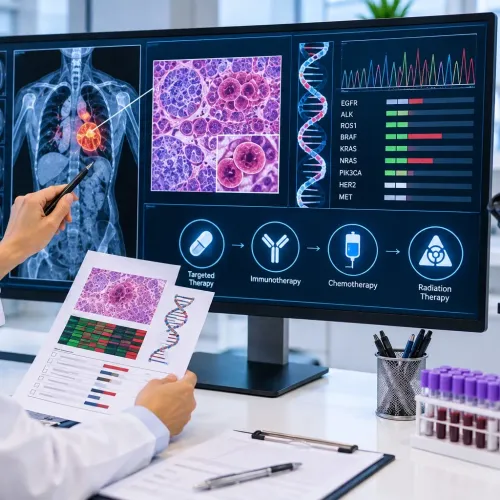
A cancer diagnosis does not identify one universal drug: treatment selection can change according to a mutation, fusion, amplified gene, abnormal protein, or repair defect found in the tumor. By the end, you will know how these features are detected, how to read the result, and why the result must be weighed against cancer type, stage, prior treatment, and your overall health.
Key takeaways
- A treatment target can be a gene, protein, receptor, or faulty DNA-repair pathway.
- Biomarker terms describe tumor findings; they do not automatically prescribe a drug.
- Doctors use tumor samples and molecular tests to identify actionable features.
- Treatment decisions also consider safety, cancer stage, prior therapy, and overall health.
How a Tumor Feature Becomes a Treatment Target
A targeted drug acts on a molecular target that helps a cancer cell grow, divide, survive, repair DNA, or attract blood vessels. That target may be a protein made by a gene, a cell receptor on the surface, a faulty DNA-repair pathway, or a signal that switches growth on.
The feature must be linked to treatment benefit before it becomes actionable. An EGFR mutation, ALK fusion, HER2 amplification, or BRCA1/BRCA2 alteration can guide therapy when clinical evidence supports a drug for that exact finding. A broad sequencing panel can find gene mutations that are merely passengers, with no effective approved treatment.
The main terms describe different findings:
| Term | What it means | Example |
|---|---|---|
| Mutation | A change in the DNA sequence | EGFR or BRAF V600 mutation |
| Amplification | Extra copies of a gene | HER2 amplification |
| Overexpression | Too much of a protein in the cell | HER2 or PD-L1 overexpression |
| Fusion | Parts of two genes joined together | ALK or ROS1 fusion |
| Biomarker | A measurable feature linked to treatment or prognosis | MSI-high status |
| Inherited genetic change | A variant present in the body’s cells and potentially passed to children | Germline BRCA1 alteration |
The same target can require different treatment for different variants, positions, or cancer types. Doctors therefore interpret the exact molecular result alongside stage, prior treatment, organ function, and the evidence for benefit.
What the Main Biomarker Terms Mean on a Test Report
The wording on a report determines whether a finding can guide treatment, requires confirmation, or has no proven drug match. These terms are related but not interchangeable.
| Term | What it means | Why the distinction matters |
|---|---|---|
| Mutation | A change in a gene’s DNA sequence, such as EGFR or BRAF V600 | The exact variant and whether it activates or disables the gene determine drug relevance |
| Amplification | Extra copies of a gene, such as HER2 amplification | More gene copies can produce more target, but a mutation in that gene is a different finding |
| Overexpression | Excess protein made by cells, measured through tests such as immunohistochemistry | High HER2 protein does not automatically mean HER2 gene amplification |
| Gene fusion | Two separate genes joined together, such as BCR::ABL1 or an ALK or ROS1 fusion | The fusion partner and breakpoint can determine whether a targeted drug works |
| Biomarker | Any measurable feature linked to diagnosis, prognosis, or treatment response | A finding becomes actionable only when evidence supports a specific treatment |
| Inherited genetic change | A variant present in normal cells from birth, also called a germline variant | It can affect relatives and prevention decisions, so confirmatory blood or saliva testing and genetic counseling may be needed |
“Mutation detected” is incomplete treatment information. Ask for the gene, exact variant, test method, classification, and clinical interpretation. The same gene can contain drug-sensitive and drug-resistant alterations, while a tumor-only finding may not be inherited.
How Doctors Find Actionable Features in Tumor Samples
Doctors usually start with a tissue biopsy at diagnosis or when cancer returns, then request biomarker testing before selecting treatment. Pathology review confirms the cancer type and checks whether the sample contains enough viable tumor.
If tissue is unavailable or insufficient, a blood test called a liquid biopsy can examine circulating tumor DNA, but a negative result does not rule out a target.
| Test | What it can identify | When it is used |
|---|---|---|
| Tissue biopsy | Tumor type, grade, and material for molecular testing | At diagnosis, recurrence, or progression |
| Immunohistochemistry | Proteins such as HER2, PD-L1, or mismatch-repair proteins | When protein expression guides treatment |
| Fluorescence in situ hybridization | Gene amplification or rearrangement, including HER2 or ALK changes | When a specific alteration needs confirmation |
| Next-generation sequencing | Multiple mutations, fusions, and other DNA changes in one panel | When several targets or trial options need assessment |
| Liquid biopsy | Circulating tumor DNA alterations | When tissue cannot be obtained or does not contain enough tumor |
Look for these details in the report:
- The exact gene and alteration, such as EGFR exon 19 deletion or BRAF V600E, not merely “mutation detected.”
- The test method, specimen date, tumor content, and whether the result is positive, negative, or indeterminate.
- The clinical interpretation, evidence level, and any statement about an approved therapy or clinical trial.
A single biopsy may miss changes present in another tumor deposit. Ask whether the finding is acquired by the tumor or suggests an inherited alteration requiring separate genetic counseling.
Why a Biomarker Result Is Not a Drug Prescription
A biomarker supports a drug only when the tumor’s disease context and the drug’s evidence match. A sequencing report can identify a molecular change without proving that the change drives the cancer or that treating it will improve outcomes.
The care team weighs five questions:
- Cancer type: Is the feature validated in this tumor, such as HER2 amplification in breast cancer or an EGFR mutation in non-small-cell lung cancer?
- Stage: Is the cancer localized, recurrent, or metastatic, and is systemic treatment needed now?
- Exact alteration: Does the report show an alteration the drug targets? ALK rearrangements and ROS1 fusions require different therapies; another change in the same gene may not respond.
- Evidence: Does a regulatory approval, clinical trial, or strong study support this drug for this feature and cancer? A finding without treatment evidence is not an automatic target.
- Treatment history: Have earlier drugs selected resistant cells, and do prior treatments, organ function, drug interactions, or your goals change the safest choice?
Several findings do not create several prescriptions. One alteration may be a passenger, while another has the strongest evidence; a clinical trial may offer the better-supported option. Some treatments apply across tumor sites, but tissue-agnostic use still requires the precise approved definition.
If the cancer progresses, repeat tissue or liquid-biopsy testing can reveal resistance changes that alter the next decision.
Turning the Molecular Result Into a Safe Treatment Decision
A safe treatment choice matches the exact alteration to the cancer type, stage, treatment history, organ function, drug interactions, and your goals—not to a gene name alone. The team also weighs response evidence, expected benefit, toxicity, route and frequency of treatment, and whether a clinical trial offers a stronger option.
| Finding | What the team verifies | Treatment implication |
|---|---|---|
| BRAF V600 | Variant, cancer type, and evidence for a matched regimen | A BRAF-directed approach may fit; another BRAF change may not |
| KRAS G12C | Exact variant and cancer-specific approval or trial data | A KRAS G12C drug is not interchangeable with therapy for another KRAS alteration |
| BRCA1 or BRCA2 alterations | Tumor versus inherited origin and evidence for DNA-repair-directed treatment | A PARP inhibitor or trial may be relevant, but the alteration’s type and cancer context matter |
| EGFR mutation, ALK rearrangement, or ROS1 fusion | Confirmed alteration and prior targeted treatment | Use the matched therapy supported for that specific driver |
Before treatment, ask which result is driving the recommendation, what benefit was shown in people with your cancer, and how the team will monitor blood counts, liver and kidney function, heart function, skin effects, diarrhoea, neuropathy, or other drug-specific harms.
Dr Gawande Oncocare Centre can use this review to connect the molecular report with medical oncology, surgery, and treatment monitoring rather than treating the report in isolation.
Resistance can appear through a second target alteration, a bypass pathway, target amplification, or cellular transformation. If the cancer progresses, ask whether repeat tissue sequencing or a liquid biopsy could identify a new treatment target or a trial.
A tumor result that suggests an inherited BRCA1 or BRCA2 change requires genetic counselling and confirmatory testing from blood or another non-tumor sample. Do not use it to guide relatives’ testing or prevention decisions until confirmation.
Frequently asked questions
What makes a tumor feature a treatment target?
A feature becomes a target when it helps cancer grow, survive, repair DNA, or form blood vessels and a treatment can act on it.
What do biomarker terms on a test report mean?
They describe molecular findings such as gene changes, proteins, receptors, or DNA-repair problems detected in the tumor.
How do doctors find actionable features in tumor samples?
Doctors examine tumor tissue with laboratory tests that identify genetic changes, protein markers, receptors, and disrupted repair pathways.
Why does a biomarker result not automatically determine treatment?
Doctors must also assess cancer type and stage, previous treatments, expected benefit, side effects, drug interactions, and your overall health.