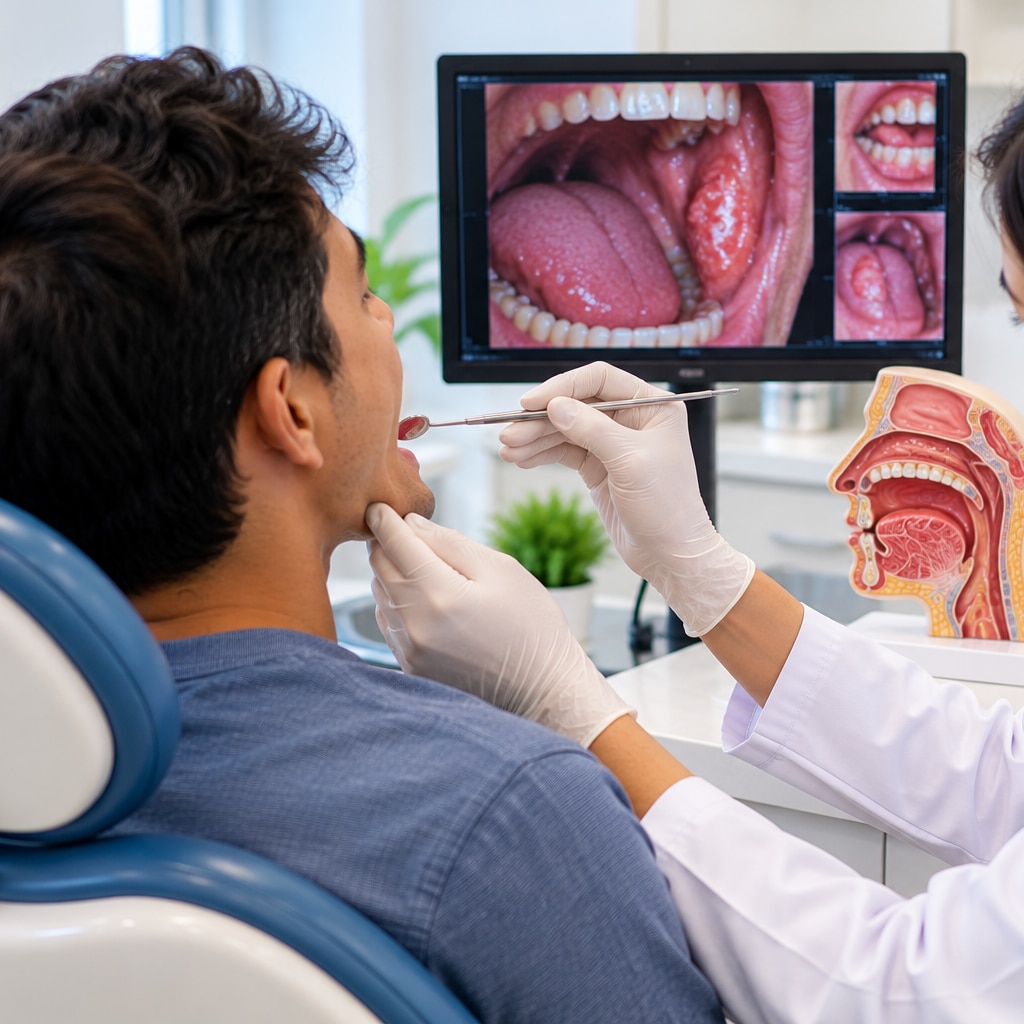
A mouth ulcer, patch, lump, or change in swallowing often has a non-cancerous explanation, but persistence and unexplained progression require attention. You will learn where to look, when to seek help, which clinician to contact, and what testing confirms or rules out oral cancer.
Key takeaways
- Have any mouth sore lasting longer than two weeks examined.
- Report persistent red or white patches, bleeding, numbness, or a neck lump.
- A biopsy confirms oral cancer; imaging helps determine its extent.
- Avoid tobacco and alcohol while arranging an examination; do not delay care.
Which mouth and throat changes should you take seriously?
A mouth ulcer that does not heal within about two weeks deserves examination, even if it is painless. Common signs of oral cancer can appear on the tongue, gums, inner cheeks, lips, floor of the mouth, hard or soft palate, tonsils, or deeper throat.
A red or white patch in mouth, mixed red-and-white area, lump, thickening, or colour and texture change can have non-cancerous causes, so appearance alone cannot confirm cancer.
| Area | Changes to notice | Other oral cancer symptoms |
|---|---|---|
| Tongue or floor of mouth | Ulcer, lump, thickened area, numbness, or reduced tongue movement | Persistent pain, bleeding, or difficulty speaking |
| Gums, inner cheeks, or lips | Red or white patch, unexplained bleeding, or a sore | Loose tooth without an obvious dental cause |
| Palate or throat | Lump, persistent sore area, or unusual swelling | Difficulty chewing or swallowing |
| Tonsils or base of tongue | Persistent asymmetry, lump, or irritation | Ear pain without an ear cause |
| Mouth or throat generally | Ongoing colour or texture change | Persistent sore throat, hoarseness, burning, or pain |
Seek prompt medical or dental assessment for these oral cancer symptoms:
- A growing lump or persistent bleeding
- Trouble swallowing or breathing
- Rapidly worsening pain, swelling, numbness, or loss of movement
- Hoarseness or throat discomfort that continues without a clear infection
Cancer is not always painful early on; waiting for severe pain can delay diagnosis.
How can you tell a warning sign from a short-lived mouth problem?
The oral cancer two-week rule is a trigger for assessment, not a diagnosis: arrange an examination if an ulcer, sore, patch, lump, or irritated area has not healed after two weeks.
A traumatic mouth ulcer from a sharp tooth, canker sore or oral cancer, gum infection, and denture rubbing can look similar at first, but a short-lived problem should improve after its cause is removed.
Seek care sooner rather than waiting two weeks if you have:
- A growing lump, persistent bleeding, or rapidly worsening swelling
- Trouble swallowing, chewing, or breathing
- Numbness, reduced tongue movement, or a loose tooth without a clear dental cause
- Severe or increasing pain, persistent throat symptoms, or hoarseness
Pain does not decide whether a lesion is serious. Early oral cancer can be painless, so waiting for burning or severe discomfort can delay assessment. A lesion that disappears and returns, remains in the same place, or has no obvious cause also deserves examination.
Oral cancer risk factors include tobacco smoking or chewing, alcohol use, and areca nut or betel quid, including preparations without tobacco. These exposures increase concern, but people without them can still develop oral cancer.
A persistent or recurring change needs a dentist or doctor to assess it; a photograph, symptom checklist, or routine blood test cannot confirm the cause.
Who should examine a suspicious area, and which tests provide a diagnosis?
A dentist or doctor should examine a mouth area that has not healed after about two to three weeks.
A dentist for mouth lesion assessment can inspect the tongue, gums, cheeks, lips, palate, floor of the mouth, throat, and neck; an oral surgeon or ear, nose and throat specialist may take over when the site is difficult to assess.
The examination includes looking for surface changes, feeling the lesion and neck, and checking cervical lymph nodes.
The usual diagnostic pathway includes these steps:
- Ask about duration, pain, bleeding, tobacco, alcohol, and areca-nut exposure.
- Inspect and palpate the entire mouth and neck.
- Take an oral cancer biopsy if the area remains suspicious. A pathologist examines the tissue under a microscope to identify cancer, its type, and its grade.
| Assessment | What it tells you | What it cannot do |
|---|---|---|
| Biopsy and microscopy | Confirms whether abnormal tissue is cancer | Does not map the full extent |
| CT, MRI, or PET/CT | Shows tumour size, nearby invasion, lymph nodes, or distant spread | Does not replace tissue confirmation |
| Screening or visual check | Finds an area that needs assessment | Does not diagnose cancer |
Screening applies to checking people before a diagnosis; a persistent lesion needs diagnostic evaluation even if you feel well. After confirmation, oral cancer staging combines examination, biopsy findings, and selected imaging to guide treatment. HPV-related cancers of the tonsils or tongue base follow a different disease pattern from many tobacco- or areca-related front-of-mouth cancers.
What should you do while arranging care, and when is delay unsafe?
A mouth sore that has not healed within two weeks is the time to see a doctor for mouth sore evaluation, even if it does not hurt. Waiting for severe pain is unsafe because early oral cancer can be painless.
If cancer is present, growth into deeper tissue or spread to neck lymph nodes in oral cancer can mean a larger operation, reconstruction, radiation, chemotherapy, or combined treatment.
Seek urgent medical care for a growing lump, persistent or uncontrolled bleeding, inability to swallow, breathing difficulty, or rapidly worsening swelling. Treat these as oral cancer emergency symptoms, especially if your airway feels restricted or you cannot swallow saliva.
Stop chewing tobacco, smoking, and areca nut or betel quid while arranging assessment; areca products without tobacco are not harmless.
To prepare for your oral cancer appointment, bring or write down:
- The date the sore, patch, lump, numbness, pain, or swallowing change began, and whether it is growing or recurring.
- A list of medicines, allergies, dental treatment, tobacco, alcohol, and areca or betel-quid use.
- Previous reports, scans, biopsy results, and the name of your dentist or doctor.
- Questions about examination of your whole mouth and neck, cervical lymph nodes, biopsy, and whether CT, MRI, or PET/CT is needed.
- A trusted person to take notes if the appointment feels overwhelming.
Do not apply caustic substances or repeatedly scrape the area before examination.
How does an oncology centre support the next steps after a concerning finding?
An oncology centre referral becomes useful after a biopsy confirms cancer, or sooner when a persistent, complex, or rapidly changing lesion needs coordinated specialist assessment. The centre can connect the biopsy result with imaging, tumour location, lymph-node findings, general health, and your treatment goals.
Ask these questions at the appointment:
- Has the biopsy identified the cancer type, grade, and any features that affect treatment?
- Which scans or examinations are needed to determine tumour size, local invasion, lymph-node involvement, or distant spread?
- Who will review my case for multidisciplinary oral cancer care, such as surgery, medical oncology, radiation oncology, dental care, and speech or swallowing support?
- What does the proposed oral cancer treatment planning involve, and why is surgery, radiation, chemotherapy, or a combination recommended?
- How could each option affect speech, chewing, swallowing, appearance, nutrition, and recovery time?
- Who will manage pain, mouth care, nutrition, tobacco or areca-nut cessation, emotional distress, and rehabilitation during treatment?
- What is the treatment timeline, and which symptoms should prompt an urgent call?
Staging is not paperwork: it determines whether treatment can remain local or requires combined therapy. Dr Gawande Oncocare Centre can be one place to discuss coordinated oral cancer care in Pimpri-Chinchwad, but ask how pathology, scans, specialist opinions, and supportive services will be brought together before you agree to a plan.
Related services
Consultation A cancer surgery consultation is a critical first step in your treatment journey. View service → |
Treatments Chemotherapy At Gawande Oncocare Centre, we understand that fighting cancer is about more than just medicine; it is about maintaining your quality of life. |
Frequently asked questions
Which mouth and throat changes should you take seriously?
Arrange an examination for a sore lasting over two weeks, a persistent red or white patch, unexplained bleeding, a neck lump, difficulty swallowing, ongoing hoarseness, numbness, or a change in how your teeth fit.
How can you tell a warning sign from a short-lived mouth problem?
Minor ulcers usually improve within one to two weeks. Persistence, growth, repeated bleeding, firm edges, increasing pain, numbness, or a nearby lump makes examination important.
Who should examine a suspicious area, and which tests provide a diagnosis?
See a dentist, oral and maxillofacial surgeon, ENT specialist, or doctor. A biopsy confirms the diagnosis; examination and scans such as CT, MRI, or PET-CT assess spread when needed.
When is delay unsafe for a possible oral cancer symptom?
Do not wait if you have breathing difficulty, inability to swallow liquids, heavy bleeding, rapidly increasing swelling, or severe dehydration. Seek urgent medical care.
How does an oncology centre support the next steps after a concerning finding?
An oncology centre can coordinate pathology review, staging scans, specialist consultations, treatment planning, and medical or surgical care based on the confirmed diagnosis.